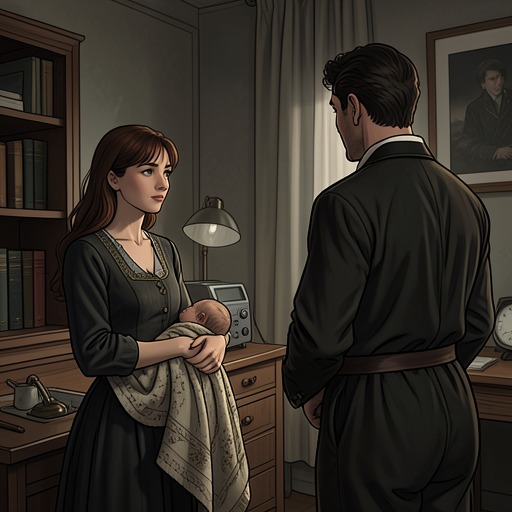
Yohan and Kazumi's marriage
The Beki CEO Got Me PregnantYohan and Kazumi's marriage is the institutional and emotional framework that converts an unexpected pregnancy into a continuing family life. It begins with Yohan's promise to assume responsibility, is publicly formalized despite Kazumi's uncertainty about his motives, and later becomes a lived partnership defined by shared childcare, domestic cooperation, and lasting affection.
Origins in Responsibility and Care
Yohan's decision to marry Kazumi is presented first as an act of responsibility toward their child rather than as a straightforward declaration of romantic love. He explains that he does not want the child to grow up confused by unfamiliar partners or by the absence of a stable family structure. He also frames marriage as a way to fulfill his responsibilities as a parent. The proposal therefore binds together pregnancy, kinship, protection, and social legitimacy, while leaving Kazumi emotionally exposed because she had hoped the proposal might mean that Yohan loved her as a romantic partner.
The marriage grows out of an already complicated history. Kazumi and Yohan had known each other since sixth grade and had remained best friends through college before separating into different lives after graduation. By the time Kazumi becomes Yohan's assistant, he is her employer and she is economically and professionally subordinate to him. That history gives their marriage an unusual double foundation: it is both the continuation of a long friendship and a new family arrangement formed under unequal workplace conditions.
Yohan's promise to provide care is made materially concrete. He tells Kazumi that he will take responsibility for her and asks her to live in his home for the time being. When she questions where her belongings will go, he has already arranged for Mang Nestor to collect them. Later, after Vixon's violence leaves Kazumi injured and bleeding, a doctor instructs Yohan to dismiss Vixon, restrict Kazumi's movement, and give her medicine for her injuries along with vitamins for the baby. These actions show the marriage emerging through protection and logistical care before it is secured through vows.
Formalization of the Marriage
The wedding takes place while Kazumi is pregnant, with only two weeks remaining before she becomes Kazumi Lhynx Laroses. The news surprises both Yohan's parents and Kazumi's parents, but neither family objects; all are happy for the couple. The family response transforms what began as a private responsibility into a publicly recognized union supported by both households.
The ceremony also exposes the difference between social roles and personal identity. When the officiant asks whether Kazumi takes Yohan as her lawful husband, Kazumi corrects the gendered wording by saying that she is the wife, not the husband. She then accepts Yohan as her husband and promises fidelity, love, and honor in good times and bad, in sickness and health. Yohan makes the reciprocal vow to take Kazumi as his wife, to hold and cherish her, and to remain with her until death parts them. The vows give their relationship a conventional marital form even though the characters' gender expression and prior understanding of Yohan's sexuality complicate that form.
The officiant's blessing explicitly links the wedding to future happiness, wisdom, and children before pronouncing them husband and wife. The ceremony thus joins three dimensions that the narrative keeps distinguishing and recombining: the legal bond between spouses, the anticipated or existing bond between parents and child, and the possibility of emotional fulfillment. Kazumi's excitement at becoming married coexists with her earlier disappointment that Yohan's proposal was motivated by responsibility rather than an avowed romantic confession.
Domestic Partnership and Shared Parenthood
After their honeymoon, Yohan and Kazumi return to the mansion for their first day of married life there. Kazumi remains at home under the watch and assistance of the household staff because she may give birth at any moment, while Yohan returns to work. The mansion becomes not merely Yohan's residence but the operational center of their marriage, pregnancy, and family life.
Yohan prepares for parenthood through practical purchases. He buys feeding bottles, a crib, and other supplies, then tells Kazumi that he has purchased things for their child. He also plans to convert an extra room on the third floor into a nursery. These preparations are important because they translate his earlier verbal promise to accept responsibility into an organized domestic environment. Parenthood is made visible through furniture, rooms, feeding arrangements, and the division of physical effort.
The couple eventually moves beyond parallel residence into coordinated caregiving. They decide to sleep in the same room so that both can monitor their child when the baby cries. They take turns and help each other during the night, despite the exhaustion. The crib is moved into their shared bedroom so that their son, baby Kenzie, remains within reach. Their marriage is therefore represented less through romantic ceremony than through repeated acts of wakefulness, supervision, feeding preparation, and mutual assistance.
This arrangement also revises the power balance between employer and assistant. Yohan initially controls the household resources and makes many of the practical arrangements, but the family routine requires both partners to respond to the baby's needs. Domestic life produces obligations that cannot be discharged by money or servants alone. The marriage becomes a cooperative parental unit, even while household staff continue to assist Kazumi during pregnancy and Yohan continues to manage the family's economic security.
Conflict, Protection, and the Limits of Stability
The marriage exists within a wider field of conflict. Yohan's company is the setting of his relationship with Kazumi as employer and assistant, and his authority there becomes entangled with his protective role at home. When Xan insults Kazumi and questions the sincerity of his behavior toward her, Yohan responds angrily, accusing him of pretending to be kind only to deceive, replace, and eventually tire of Kazumi. Yohan orders Xan to leave the company. His defense presents marital loyalty as a public stance, not merely a private feeling.
Vixon's violence creates a more serious threat to the family's stability. After learning that Kazumi has been injured, Yohan tells the doctor that he believes Vixon attacked her. The doctor recommends that Vixon be fired and that Kazumi rest. The workers subsequently call the police, and Vixon is imprisoned for two years. Yohan feels some relief after Vixon's arrest but recognizes that he and Kazumi must still remain careful. The marriage thus functions as a refuge, but not an invulnerable one: its domestic security depends on confronting violence outside the home and managing the consequences of Yohan's workplace authority.
The eventual danger becomes extreme when Vixon appears to have tried to kill Kazumi. A police officer tells Yohan that the incident must be reported because Vixon attempted to kill her, while Yohan stares at Vixon as though he is dead. This moment marks the point at which the marriage's protective promise is tested against criminal violence. The family is not stabilized simply by the wedding; its continuity requires legal intervention, vigilance, and the removal of a direct threat.
Enduring Family Life
The marriage's later meaning is measured by duration and repetition. Ten years later, Yohan and Kazumi remain deeply in love with each other. Their intimacy is shown through an ordinary domestic scene in which Yohan lies with his head on Kazumi's lap; when Kazumi asks him to get Mamon for Yzkael, he rises, brings the food, and gives it to the child. The gesture is small, but its familiarity demonstrates that their relationship has survived the pressures that first created it.
The scene also places the marriage within a larger family. Kenzie and Yisha eat Mamon while Yzkael receives his portion from Yohan, turning the couple's former crisis into a multigenerational household rhythm. The marriage has moved from a hurried solution to pregnancy into a durable structure of care in which affection is expressed through shared space, children, food, and unremarkable acts of service.
Yohan and Kazumi's marriage therefore remains deliberately layered. It is a legal union formed during pregnancy, a household built around parental responsibility, a partnership shaped by workplace and economic power, and eventually an enduring romantic relationship. The narrative does not make these meanings identical at the beginning. Instead, it shows marriage acquiring emotional substance through protection, cohabitation, conflict, childcare, and the repeated choice to remain together.